
REVIEW · TOKYO SUMO TOURS
Complete Sumo Experience in Tokyo
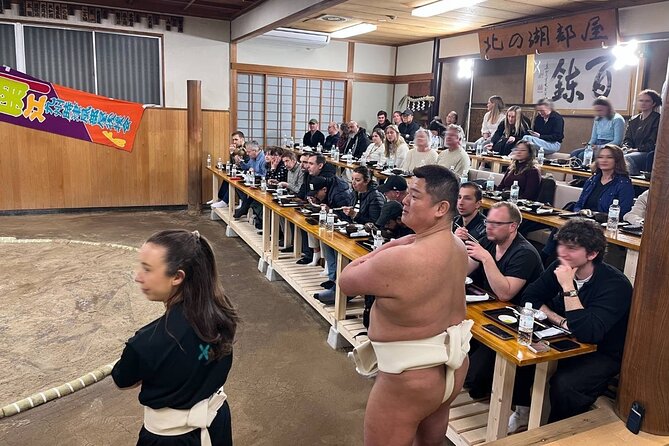
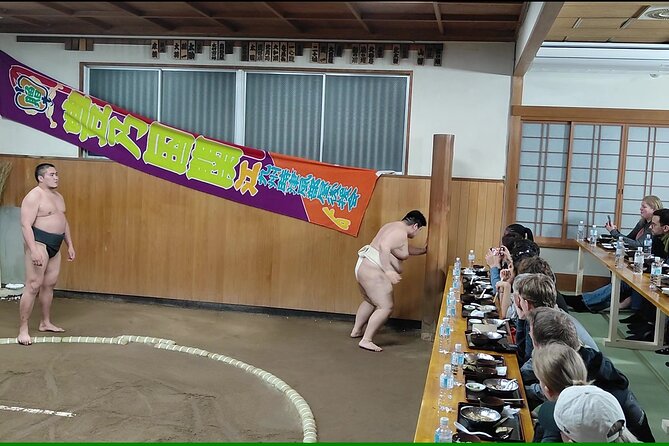
The best part of this Tokyo sumo experience is the close-up view. You are not watching tiny figures from an arena seat. You sit near the action in a traditional stable, see wrestlers train, watch matches, and get a chance to ask questions and take photos afterward.
I like the clear introduction to sumo culture, and I like the meal option. Chanko nabe, the hearty hot pot associated with sumo wrestlers, gives the evening sessions a useful food-and-culture link. The wrestlers also bring humor to the event, especially during the audience participation.
The main caution is pacing. The audience challenge can run longer than some people expect, and the meal option applies only to the 11 AM and 7 PM starts. If you want the best seat, arrive early.
Key points to know before booking
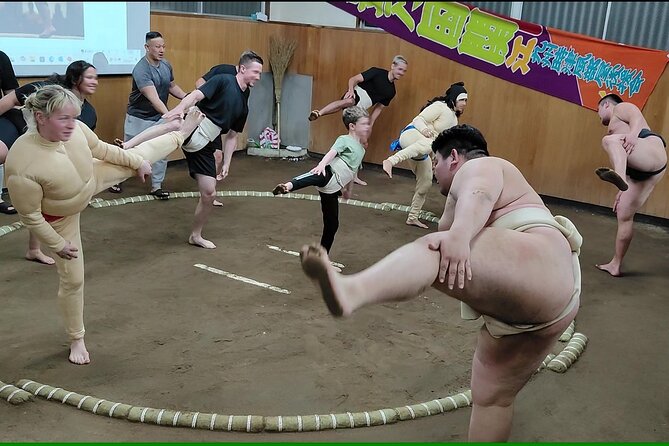
- Watch sumo at stable level: You see training and matches from close range rather than from a large arena.
- Choose your timing carefully: The 11 AM and 7 PM sessions include chanko nabe, while the 3 PM session does not.
- Expect active participation: You may be invited to challenge a wrestler, so this is more than a sit-down demonstration.
- Ask questions directly: A sumo expert explains the sport, followed by a Q&A with the wrestlers.
- Plan for a small group: The maximum group size is 30 people, which helps keep the action personal.
- Arrive early for seating: The strongest practical tip is to get there ahead of time if your position in the room matters.
Why this sumo experience feels different
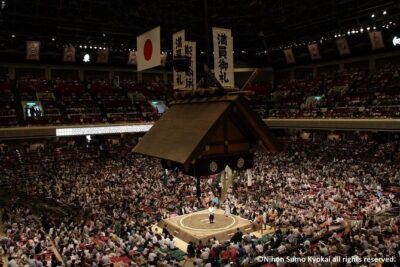
Tokyo gives you two familiar ways to see sumo. You can buy a seat at a grand tournament, or you can try to watch morning practice at a stable. Both have value, but each has limits. A tournament can be expensive and crowded, while stable practice may not offer much explanation or direct contact.
This experience combines the useful parts of both. You see a working sumo setting, learn the basic culture and techniques, watch wrestlers train, and see actual matches. You also get a chance to speak with them and take photographs.
That combination matters if you are new to sumo. The sport can look simple at first glance: two large men pushing, pulling, and trying to force one another out of the ring. The crash course gives you a better sense of the rules, origins, and ritual behind those movements. Once you know what to watch for, a short bout becomes much more interesting.
The event lasts about two hours. That is long enough for a useful introduction without taking over your entire day in Tokyo. It also gives the session room for explanations, demonstrations, questions, photos, and audience participation.
More sumo experiences in Tokyo:
- Tokyo: Sumo Show Experience with Chicken Hot Pot and a Photo
★ 4.8 · 6,678 reviews - Tokyo: Sumo Show and Dining Experience
★ 4.8 · 2,742 reviews - the SUMO show
★ 5.0 · 1,960 reviews
Arriving at the Koto City sumo stable
The meeting point is at Kiyosumi 2-chome in Koto City, Tokyo, at the listed address for Kitanoumi Stable. The activity ends at the same location, so you do not need to arrange a second pickup point afterward.
Hotel pickup and drop-off are not included. You need to make your own way to the stable, but the location is near public transportation. Build in extra time, particularly if you are unfamiliar with Tokyo’s station exits and neighborhood streets.
Arriving early is smart for two reasons. First, you will have time to find the correct entrance without rushing. Second, seating can affect the quality of your view. The room is limited to a maximum of 30 people, but that does not mean every seat offers the same angle.
The address includes Japanese characters and numbers that may look confusing when copied into a map app. Save the meeting point before leaving your hotel, and check the route earlier in the day. You do not want to begin a traditional Japanese sports experience by sprinting through Koto City with your phone held out like a compass.
The opening crash course in sumo
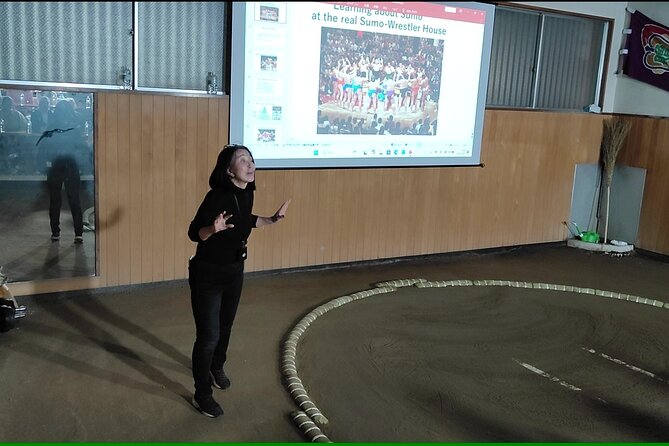
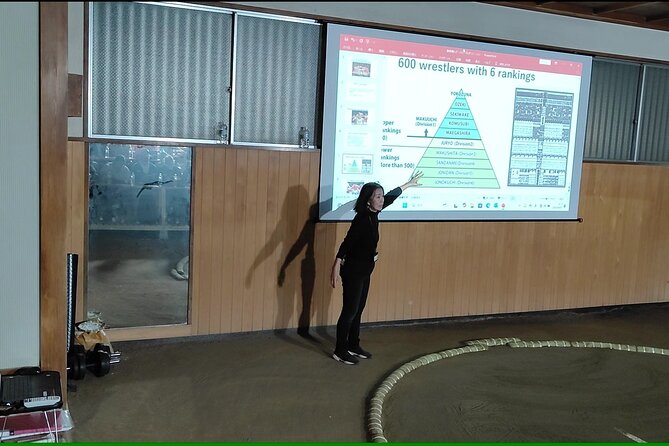
The experience starts with an explanation of sumo. An expert introduces the origin, history, and culture of the sport, along with the techniques used in combat.
This opening is more important than it may sound. Sumo has a large amount of ceremony and tradition, and a first-time spectator can miss the point of what happens before the actual pushing begins. The introduction helps you understand why the sport is treated as more than a simple contest of strength.
You should come away with a clearer idea of how the bouts work and what the wrestlers are trying to do. The explanations also give context to the movements you see later in the session.
The teaching style is designed for people with different levels of interest. If you already follow professional sumo, you may find the basic material familiar. For most first-time visitors, though, this section makes the rest of the experience easier to follow.
It also gives you a chance to settle in before the action starts. This is not a rushed photo stop. You have time to listen, look around the stable, and understand the setting.
Watching training and close-range matches
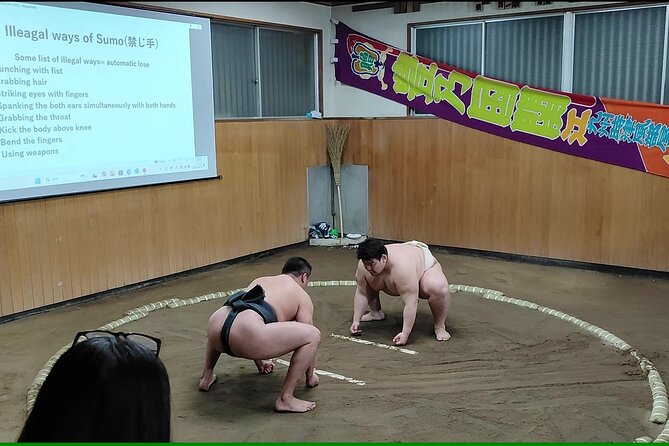
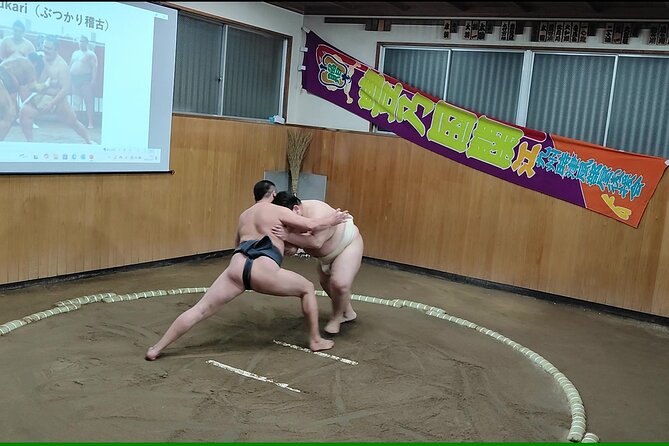
The main attraction is watching wrestlers train and compete at close range. A grand tournament gives you the drama of a full competition day, but an arena seat places you at a distance. Here, the room itself is part of the experience.
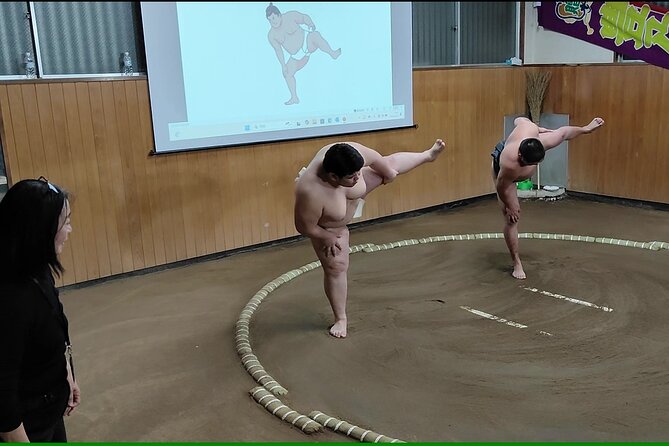
You can see the physical effort of training more directly. The activity promises both training and actual matches, so you get a fuller picture of sumo than a single staged bout would provide. The best way to use this part of the event is to pay attention to the technique rather than only the size of the wrestlers.
Sumo rewards balance, timing, positioning, and leverage. The opening explanation should help you identify those elements as the wrestlers move. You may find that a short match feels more suspenseful once you understand that a competitor does not need to overpower an opponent in a straight contest of force.
The close seating is also useful for photography, although you should follow any instructions given by the staff. The atmosphere is more personal than a major tournament, and you are likely to notice the sound and impact of each movement more clearly.
There is a trade-off. This is a prepared experience rather than a full competition day, so you should not book it expecting the scale, ceremony, or variety of a grand tournament. Its strength is access and explanation, not the spectacle of a huge sporting event.
Another way to get close to the sport:
- Tokyo Shinjuku Sumo Show & Experience with Photo
★ 5.0 · 1,750 reviews - Tokyo Sumo Entertainment Show with Chicken Hot Pot and Photo
★ 5.0 · 1,205 reviews - Tokyo: Sumo Show and Experience in Shinjuku
★ 4.8 · 1,001 reviews - Tokyo: Sumo Tournament Tour with Chair Seat Tickets
★ 4.6 · 753 reviews
The audience challenge and the comic relief
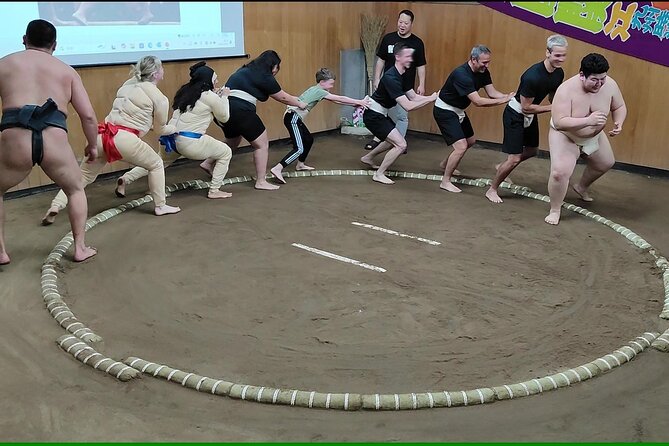
One of the unusual features is the chance to challenge a sumo wrestler. This turns you from a spectator into part of the demonstration, at least briefly.
The audience participation creates a friendly, humorous mood. The wrestlers are not simply showing technique from a distance. They invite selected participants into the action, and the event uses that moment to show the difference between ordinary strength and sumo training.
You do not need to be a sumo expert to enjoy this part. You can watch others take part and still learn from the demonstration. If you are selected, expect the emphasis to be on fun rather than on proving yourself against a professional wrestler.
There is one practical warning: this section may feel long if you prefer a tighter sports presentation. The participation is a major part of the atmosphere, but it can slow the pace for people who mainly want training and matches.
I would think of it this way: if you enjoy being involved, the challenge is one of the reasons to choose this event. If you want a quiet, highly structured observation session, a morning practice visit may suit you better.
Meeting wrestlers after the action
The Q&A session adds a human side to the sport. You can ask the wrestlers questions directly, rather than relying only on a guide’s explanation.
That exchange is valuable because it helps connect the formal traditions of sumo with the people who practice it. You can ask about the techniques you have just watched, the training session, or the culture surrounding the stable. The supplied information does not list the wrestlers’ names or provide a set list of questions, so the exact conversation will vary.
The tone is friendly and relaxed. The wrestlers are described as funny and willing to participate, which helps keep the presentation from feeling stiff. This is especially useful for families and first-time visitors who may not know much about sumo before arriving.
After the questions, you can take photos with the wrestlers. A photo session gives you a clear souvenir and a chance to remember the setting, not just the match itself. As always, follow the staff’s instructions about timing and where to stand.
Chanko nabe at the 11 AM and 7 PM sessions
The meal option is one of the strongest reasons to choose a specific start time. At the 11 AM and 7 PM sessions, you watch the show over chanko nabe, the hot pot eaten by sumo wrestlers to help build their muscles and bodies.
This makes the meal part of the subject, not just an extra dinner added to a sports show. You are eating the food connected with the wrestlers while watching the training and matches. That link gives the event a stronger cultural focus.
The food received especially warm praise, and it is described as tasty and excellent. Still, you should not assume that the meal replaces all other food needs or that the menu will suit every diet. The supplied details do not specify ingredients, portion size, or dietary accommodations, so ask the provider if those points matter to you.
The meal format can also affect your attention. You are eating while watching, which makes the evening session feel social and relaxed, but it may be less focused than a pure performance. Some people will love the combination. Others may prefer to watch without handling food.
The 3 PM session does not include chanko nabe. That option may work better if you already have dinner plans, want the shortest food commitment, or simply care more about the sumo than the meal. Check the selected time carefully before paying, since the meal is tied to the start time.
Is $138.52 a fair price?
At $138.52 per person, this is not a cheap way to spend two hours in Tokyo. The value depends on what you want from a sumo visit.
The price includes a sumo crash course, training, matches, a Q&A, and photos with the wrestlers. The 11 AM and 7 PM choices also include chanko nabe. You are paying for direct access and a structured introduction, not only a seat in a room.
I see the value most clearly for visitors who cannot attend a grand tournament during their stay. Tournament tickets can be tied to a limited schedule, and a morning stable visit may not include this level of explanation or audience contact. This event puts the main elements into one compact session.
The price is harder to justify if you only want to watch a bout. You may find less expensive ways to see sumo-related material, but they will not necessarily offer the same chance to challenge wrestlers, ask questions, and take photos.
The average booking lead time is about 57 days. That suggests you should not leave this until the last few days of a busy Tokyo trip, especially if you want a particular start time. The group limit of 30 helps explain part of the cost, since the event is designed around a more personal setting rather than a large crowd.
Who will enjoy this most?
I would recommend this experience to first-time sumo visitors, families, curious food lovers, and anyone who wants contact with the people behind the sport. The explanation makes it approachable, while the challenge and photos keep it from feeling like a lecture.
It also suits a short Tokyo itinerary. In roughly two hours, you can learn the basics, watch training and matches, eat chanko nabe at selected times, and meet the wrestlers. The meeting point is fixed, and the activity returns you there, which keeps the plan simple.
You may want to skip it if your main goal is to see a full professional tournament. This is a close-up introduction, not a replacement for a day at the arena. You may also find the audience participation too long if you prefer a fast-moving sports event.
Most people can participate, and the activity is near public transportation. Still, the information provided does not give detailed accessibility specifications, so contact the provider if you need particular arrangements.
Booking confirmation is provided at the time of booking, and free cancellation is available up to 24 hours before the start time. Cancellations or changes made less than 24 hours before the start are not accepted for a refund.
Should you book this Tokyo sumo experience?
Book it if you want access, explanation, and interaction in one compact visit. The strongest package is probably the 7 PM option with chanko nabe, since you get the food connection, an evening activity, close-range sumo, wrestler questions, and photos.
Choose the 11 AM session if it fits your sightseeing plan better. Choose 3 PM if you do not want the meal. Arrive early for a better seat, and remember that the audience challenge is part of the event rather than a minor extra.
Skip it if you want the scale and formal drama of a grand tournament. For everyone else, this is a practical way to understand sumo beyond the arena and meet the wrestlers in a friendly setting.
FAQ
Where does the sumo experience take place?
It starts at Kitanoumi Stable at Kiyosumi 2-chome, Koto City, Tokyo, with the listed address of 135-0024 Tokyo, Koto City, Kiyosumi, 2-chōme1011. The activity ends back at the meeting point.
How long does the experience last?
The activity lasts approximately two hours.
Which start times include chanko nabe?
The 11 AM and 7 PM sessions include a chanko-nabe meal. The 3 PM session does not include the meal.
What is included in the experience?
The price includes a sumo crash course by an expert, training and matches by sumo wrestlers, a Q&A session, and photo sessions with the wrestlers.
Can I challenge a sumo wrestler?
Yes. Audience members have the opportunity to challenge wrestlers as part of the experience.
Can I ask the wrestlers questions?
Yes. A Q&A session with the sumo wrestlers is included.
Is hotel transportation included?
No. Hotel pickup and drop-off are not included. You need to travel to and from the meeting point yourself.
What is the cancellation policy?
You can cancel up to 24 hours before the experience start time for a full refund. Cancellations or changes made less than 24 hours before the start are not accepted, and the amount paid is not refunded.
Newest sumo experiences in Tokyo
- TOKYO , No1 Yokozuna Stable Morning Practice in Ryogoku★ 4.5 · 3 reviews
- Tokyo 6hr Private Guided Tour & Sumo Show Lunch★ 5.0 · 3 reviews
- Tokyo Grand Sumo Tournament Viewing Tour★ 5.0 · 2 reviews
- Tokyo Sumo History Tour with Chanko Nabe Lunch★ 5.0 · 3 reviews
- Tokyo Highlights Tour: Sumo, Sushi, Tea, and Tokyo Tower★ 5.0 · 2 reviews
- Tokyo: Know about Hokusai and Sumo culture in 2.5 hours★ 5.0 · 2 reviews
- Tokyo: Sumo Keiko Training Tour with Audio Guide & Photo★ 4.8 · 5 reviews
- Tokyo: Watching Sumo and Ryogoku Area Walking Tour★ 4.0 · 5 reviews
Tokyo Sumo Tours, compared.
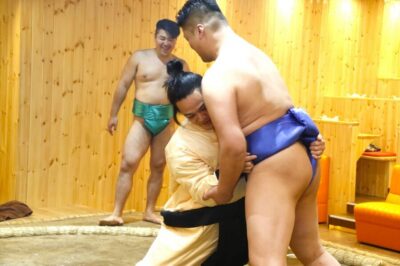
Sumo Show Experience with Chicken Hot Pot and a Photo
Read our review →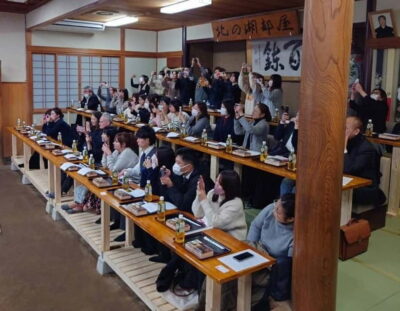
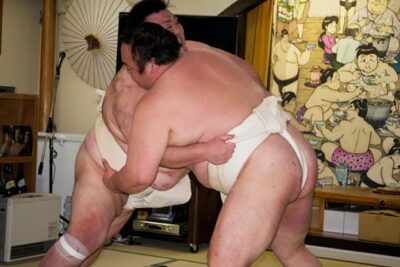
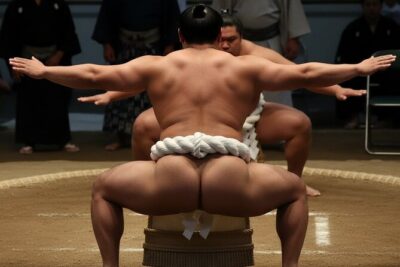
Tokyo Shinjuku Sumo Show & Experience with Photo
Read our review →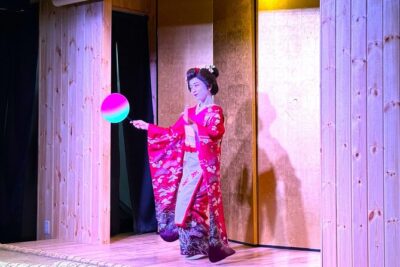
Tokyo Sumo Entertainment Show with Chicken Hot Pot and Photo
Read our review →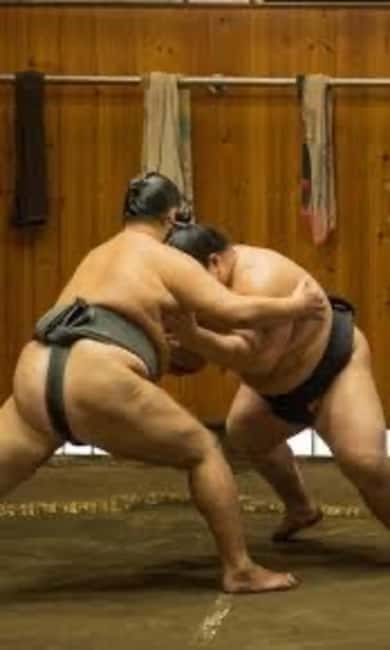
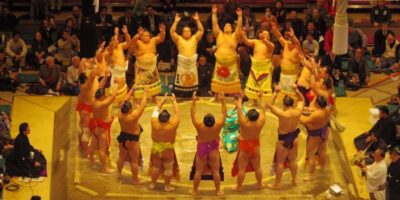
Tokyo Grand Sumo Tournament Viewing Tour with Tickets
Read our review →Browse the lists this tour appears in