
REVIEW · SUMO STABLE VISITS
Watch Sumo Morning Practice at Stable in Tokyo
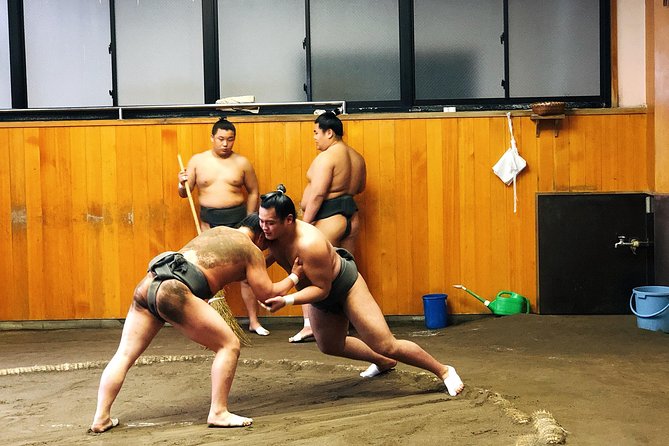
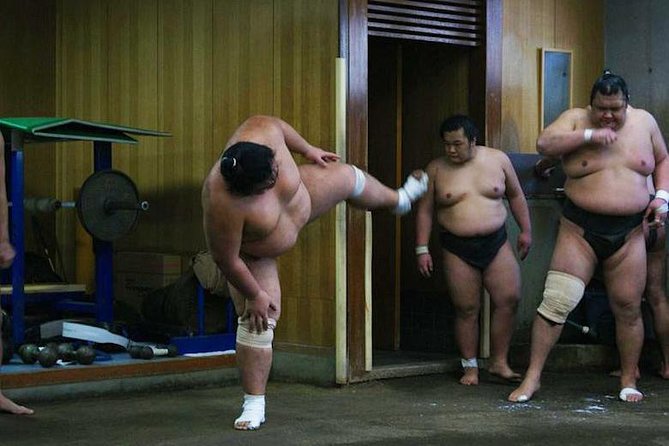
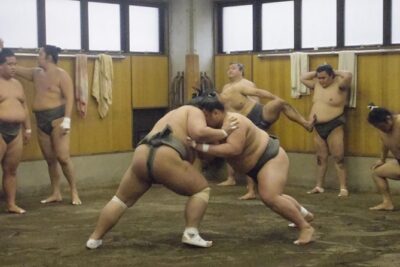
Tokyo’s sumo morning practice is not a show staged for tourists. You sit quietly at the edge of a working stable while wrestlers stretch, slap their bodies, practice footwork, and collide in the dohyo. The slow build from warm-up to hard sparring gives you a close look at the discipline behind the sport.
I like the authentic setting and the chance to see the wrestlers at close range. I also like the small-group format listed for the activity, plus the chance for photos afterward. The drawback is clear: you may sit on a hard floor for a long time, with little explanation and no guarantee of a full-length practice.
Key points before you book
- This is a real training session, not a performance: The wrestlers follow their normal practice, so the pace can be repetitive and quiet.
- The action builds slowly: Expect stretching and drills first, followed by more forceful contact and sparring.
- Floor seating matters: You need to sit for an extended period, often with your legs tucked or crossed.
- Practice times can change: Most sessions last 60 to 90 minutes, but Tokyo tournament-season visits may last only 30 to 40 minutes.
- Photos are included, but timing is not guaranteed: A late-running practice can shorten or remove the photo session.
- Arrive ready for a strict setting: No food, loud talking, bright flash, or intrusive camera sounds.
What you are really seeing at a Tokyo sumo stable
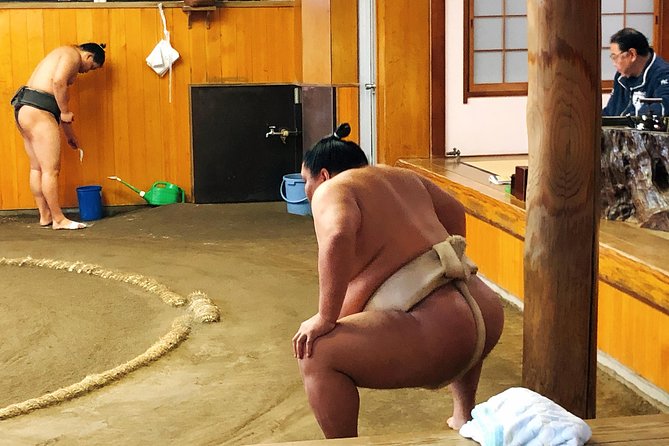
A sumo stable is both a training center and a home for wrestlers. This experience gives you a look at the training side of the sport, not the polished atmosphere of a tournament at Ryogoku Kokugikan.
You begin at a prearranged meeting point in Tokyo and then enter the stable with your guide and group. The exact stable and final conditions depend on the stable’s schedule, which can be confirmed only about a week before the visit. That late confirmation is a practical nuisance, but it reflects how these places operate. The stable’s training calendar comes first.
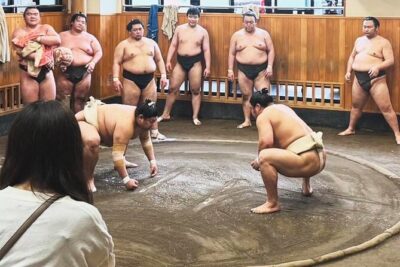
Inside, you take a place along the side of the room. You may sit on the floor or on a small raised area, depending on the stable. The room is quiet because the wrestlers are working. This is not the moment for a running commentary, questions shouted from the audience, or constant photography.
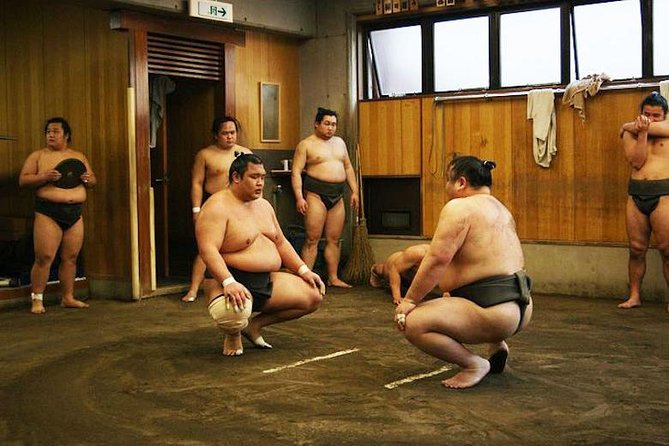
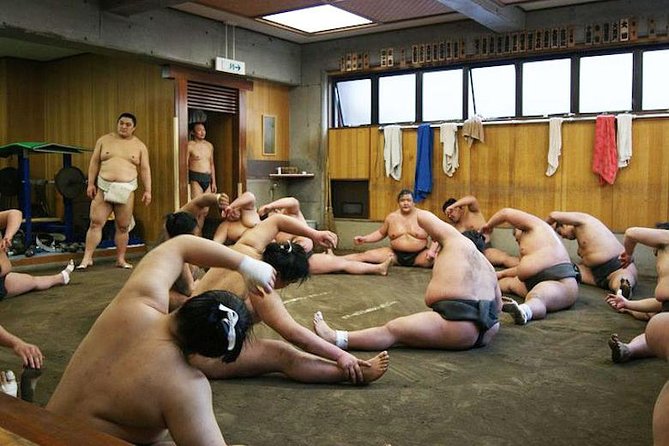
You watch the wrestlers begin with stretching and warm-up exercises. The first part can look repetitive, especially if you are expecting nonstop bouts. That repetition is part of the point. Sumo depends on balance, leg strength, timing, flexibility, and the ability to absorb a powerful impact. The practice shows how much work comes before a match lasts only a few seconds.
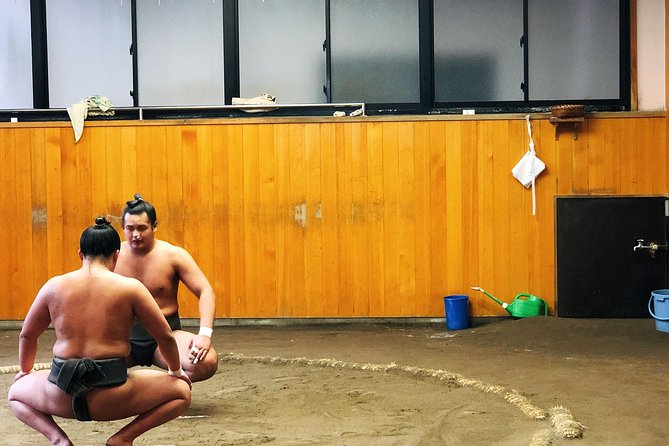
As the session develops, the exercises become more physical. Wrestlers face each other in the dohyo, repeat movements, and engage in bouts or sparring. The sound and force of the collisions are difficult to judge from television. From a few feet away, the physical weight of the sport becomes much easier to understand.
The wrestlers may also talk, joke, advise one another, or support less experienced members of the stable. That informal interaction can be as interesting as the formal drills. You are seeing a team at work, with senior and junior wrestlers sharing a demanding routine.
More stable visits in Tokyo:
- Tokyo Sumo Morning Practice Tour at Stable
★ 5.0 · 298 reviews - Tokyo: Sumo Morning Practice Viewing Tour at a Real Stable
★ 5.0 · 73 reviews - Tokyo: Sumo Morning Practice Viewing Tour at a Real Stable
★ 4.9 · 32 reviews
Why the quiet rules are part of the experience
You are asked not to eat, talk loudly, use bright flash photography, or make intrusive camera sounds. These rules may feel strict, but they protect the practice from becoming a photo opportunity built around the audience.
I like this part of the arrangement. It keeps the focus on the wrestlers and makes the visit feel less like entertainment. You are there to observe a professional training session, not to interrupt it.
The silence also changes how you watch. You begin to notice small details: the repeated motions, the care given to foot placement, the way wrestlers prepare before contact, and the different levels of experience within the room. If you already know something about sumo hierarchy and basic rules, you will get more from the session. Reading a short introduction beforehand helps, and watching Sanctuary was specifically suggested by one attendee as useful preparation.
The downside is that the quiet format leaves some visitors with unanswered questions. The guide may simply lead you to the stable and manage the visit, rather than provide a full explanation in your language. Some departures appear to include stronger interpretation than others. One arrangement included Hiroko and Ricko, with Ricko helping organize transport and explain the visit, but you should not assume that the same guides will be present every day.
The seating problem is real
The biggest practical issue is the floor. You may sit cross-legged, with your legs tucked to one side, or in another position that keeps your feet from pointing toward the wrestlers. The mat can be thin over a hard surface, and the session may run for 60 to 90 minutes.
A chair or stool may be available by advance request, but the view can be worse. Some accounts describe only a couple of chairs, so do not count on a comfortable seat unless the operator confirms it. If you have back, hip, knee, or leg problems, treat this as a serious booking decision rather than a minor detail.
Getting there early can help with your view. Several accounts describe better sightlines from the front, while people in the back may have difficulty seeing past other seated visitors. The activity information gives a maximum of 10 participants, although some accounts describe larger groups. Because seating is close together, confirm the expected group size and chair arrangements before paying if those points matter to you.
Wear clothing that lets you sit comfortably. You will also need to follow the stable’s etiquette once inside. This is not a place to stretch your legs freely, wander around for a better photo, or leave and return whenever you wish.
From warm-up to hard contact
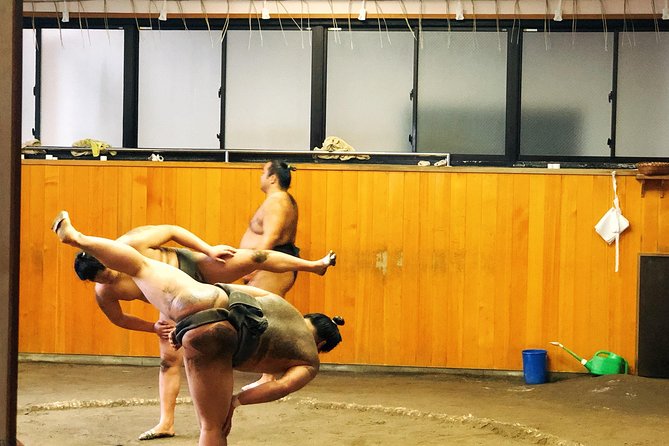
The training usually follows a gradual pattern. First come stretches and basic movements. Then the wrestlers work through techniques and repeated drills. Later, you may see the more dramatic part: forceful contact and sparring.
That progression makes the experience worthwhile for people who want to understand the work behind sumo. The most impressive moments are not always the loudest. A wrestler holding a low stance, repeating a movement, or bracing for impact shows the strength and control needed before competition.
Still, you should set your expectations correctly. There may be long periods of stretching. One person found 25 minutes of repeated exercise boring, while another family enjoyed watching the complete build from warm-up to sparring. Both reactions make sense. If you need constant action, this may feel slow. If you enjoy watching athletes train, the routine is the attraction.
During tournament season in Tokyo, practice can be shorter. The listed Tokyo tournaments occur in January, May, and September, generally around the 15th to 25th. At those times, the session may last only 30 to 40 minutes, and the price remains the same. The practice schedule can also change because tournaments take place in other months and stables may be closed.
The ending time is not fixed. A practice that runs longer can affect transport plans and the photo session. Do not schedule a tight museum reservation, airport transfer, or important meal immediately afterward.
More morning practice tours in Tokyo:
- Tokyo: Sumo Morning Practice Viewing Tour
★ 4.8 · 570 reviews - Tokyo: Sumo Morning Training Visit
★ 4.4 · 370 reviews - Tokyo: Visit Sumo Morning Practice with English Guide
★ 4.7 · 343 reviews - Tokyo: Sumo Morning Practice Tour at Sumida City
★ 4.8 · 308 reviews
The photo session comes last, when possible
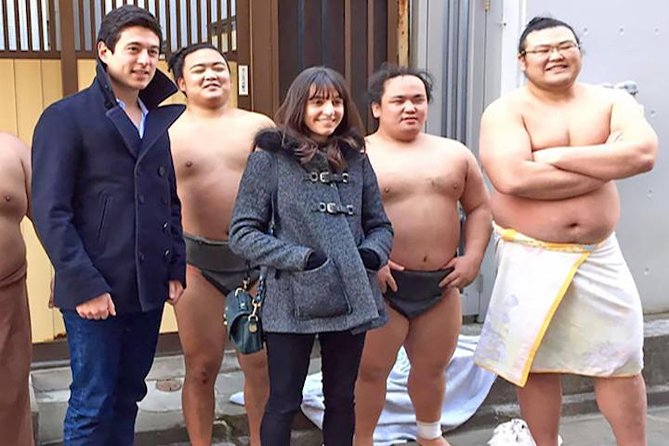
Photos with the wrestlers are included. Usually, this happens after practice, when the formal observation portion is finished.
This can be a memorable closing moment, especially because you have just watched the wrestlers work at close range. But it is not guaranteed in the practical sense. If the practice runs long, there may be too little time for photographs. Some participants missed the photo session for that reason.
Keep your camera ready, but do not use bright flash or intrusive sounds during practice. Follow the guide’s instructions about when photos are allowed. The photo is a pleasant extra, but the main value of the visit is the training itself.
Getting there and managing the morning
You make your own way to the meeting point in Tokyo. The experience ends back at the meeting point, but the exact stable location may be sent only shortly before the visit because the stable’s schedule is not settled until about a week in advance.
The sumo area around Ryogoku is accessible by public transport, but the final walk can be harder than expected. Some people have found a taxi from Asakusa easier, especially when carrying luggage or trying to arrive early. If you use a taxi, keep the address in Japanese. English-only directions may not be enough for every driver.
Allow extra time. A late arrival can mean a poor seat or a rushed entry. Since practice begins in the morning, you also need to be comfortable with an early start. The listed operating windows are 8:00 AM to 10:00 AM, Monday through Saturday, on selected dates in February, March, April, and May 2026. The stable, not the visitor schedule, controls the final timing.
Confirmation is sent within 48 hours of booking, subject to availability. Since dates and locations can shift with the stable’s schedule, do not build your entire Tokyo plan around this until the booking is confirmed.
Is $95.77 a fair price?
At $95.77 per person, this is not a cheap sightseeing stop. You are paying for access to a working stable, an arranged meeting process, entry, and the chance to watch a practice that most independent visitors cannot simply walk into.
The value depends on your interest. If sumo is high on your Japan list, the close view and genuine training environment can justify the cost. You see the wrestlers before the public spectacle, and you get a better sense of the preparation, hierarchy, rituals, and physical strain.
If you are only mildly curious, the price is harder to defend. You may spend much of the session watching warm-ups in silence, and the guide’s explanation may be limited. The experience is not designed as a broad introduction to Japanese culture with a lecture, meal, or extended neighborhood walk.
Group discounts may be available, which could help families or small parties. The minimum age is 13, so this is aimed at older children and adults who can stay quiet and sit still. Food and drinks are not included.
Who will enjoy this most
I would choose this for a visitor who wants a close look at a traditional sport and is willing to follow local etiquette. It suits people who enjoy process, ritual, training, and small details more than people seeking a fast, theatrical attraction.
It can work well for families with teenagers. One family found the session held the attention of teens because the practice moved from slow preparation to powerful sparring. It also suits sports fans who want to compare sumo with other team or combat sports.
You should think twice if you have trouble sitting on the floor, dislike quiet observation, or need a fixed end time. You should also avoid booking it as a guaranteed photo opportunity. The photo is included, but an extended practice can change the schedule.
The tour has a rating of 4.2 from 268 ratings, which fits the nature of the experience: deeply memorable for people who value authenticity, but frustrating for those who want comfort, explanations, or predictable timing.
Cancellation and booking cautions
You can cancel at least six full days before the start time for a full refund. A cancellation two to six full days ahead receives a 50 percent refund, while cancellation less than two full days ahead receives no refund. Changes are not accepted close to the activity, and the operator specifically warns that flight delays, illness, or other late problems are treated as cancellations.
You should also note that the stable’s schedule is confirmed late. If a stable closes or cannot host the visit, another date or a refund may be offered. Weather-related cancellation also allows a different date or full refund.
Should you book the sumo morning practice?
Book it if you want to see sumo as a demanding daily discipline, not just a tournament spectacle. The close seating, serious atmosphere, repeated drills, and sudden bursts of physical power can make this one of the most memorable cultural activities in Tokyo.
Skip it if you need comfort, detailed guiding, or a firm timetable. Before booking, ask about the expected stable location, group size, floor seating, chair availability, and whether the practice falls during Tokyo tournament season.
My advice is simple: read up on basic sumo etiquette, arrive early, dress for floor seating, leave your morning open, and treat the visit as quiet observation. With those expectations, the $95.77 price can be reasonable. Without them, a slow practice on a hard floor may feel like a poor use of your morning.
FAQ
How long does the sumo practice experience last?
The activity is described as lasting between 60 and 90 minutes on most days. During Tokyo tournament season in January, May, and September, practice may last only 30 to 40 minutes.
Where does the activity start and end?
You meet at a prearranged location in Tokyo, travel to the sumo stable, and return to the meeting point when the activity ends.
Is the sumo stable location confirmed at booking?
The stable’s conditions depend on its schedule, which can be confirmed about one week before the experience. Booking confirmation is sent within 48 hours, subject to availability.
Can I take photos during the practice?
You may take photos when permitted, but bright flashes and intrusive camera sounds are not allowed during practice. Photos with the wrestlers are included at the end when timing allows.
Do I need to sit on the floor?
Yes. Participants should be able to sit on the floor for an extended period. A chair or stool may be available by advance request, but seating is limited and the view may not be as good.
Is food or drink included?
No. Food and beverages are not included.
What is the minimum age?
The minimum age is 13.
Can I cancel for a full refund?
Yes, if you cancel at least six full days before the experience start time. Cancellations two to six full days ahead receive a 50 percent refund, and cancellations less than two full days ahead are not refunded.
Newest sumo experiences in Tokyo
- Tokyo Sumo History Tour with Chanko Nabe Lunch★ 5.0 · 3 reviews
- Tokyo Highlights Tour: Sumo, Sushi, Tea, and Tokyo Tower★ 5.0 · 2 reviews
- Tokyo: Know about Hokusai and Sumo culture in 2.5 hours★ 5.0 · 2 reviews
- TOKYO , No1 Yokozuna Stable Morning Practice in Ryogoku★ 4.5 · 3 reviews
- Tokyo 6hr Private Guided Tour & Sumo Show Lunch★ 5.0 · 3 reviews
- Tokyo Grand Sumo Tournament Viewing Tour★ 5.0 · 2 reviews
- Tokyo Ginza : Sumo and Mikoshi Experience,Open from Sep.★ 5.0 · 8 reviews
- Complete Sumo Experience in Tokyo★ 4.5 · 3 reviews
Sumo Stable Visits, compared.
Sumo Morning Practice Viewing Tour at a Real Stable
Read our review →Sumo Morning Practice Viewing Tour at a Real Stable
Read our review →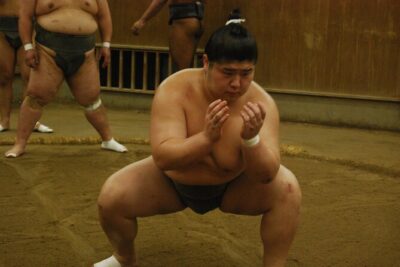
Sumo Morning Practice -Stable Visit Tour with a Guide
Read our review →Sumo Morning Practice -Stable Visit Tour with a Guide
Read our review →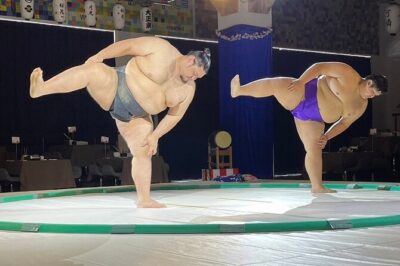
Up-Close Sumo Experience at Ochi Stable: Wear Kimono in Osaka
Read our review →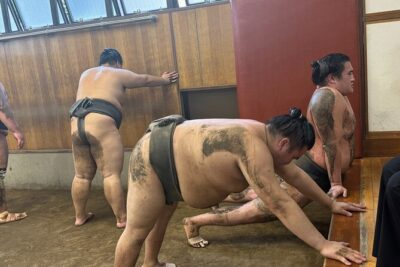
Browse the lists this tour appears in